

Private markets are hardly new to diversified portfolios. Over the last three decades institutional investors have increased their exposure to alternative assets, and for good reason.
Private markets give access to a far larger part of the economy than listed markets alone. Most companies are private, and many of the best-known now stay private for longer, so a portfolio limited to public assets misses a growing share of economic activity. Private equity, private credit, infrastructure and real assets also offer a level of differentiated return sources to listed equities and bonds. These often include contractual income and active ownership that lets managers drive change inside the business. Their performance has historically moved somewhat differently from listed markets, which can improve diversification and support more resilient long-term outcomes.
The past decade has shown a material ramp-up in private evergreen or “semi-liquid” funds, particularly into non-institutional channels. Investors around the world saw them as offering compelling attributes and an alternative to volatile listed markets. With market tensions on the rise however, investors are relearning the ‘semi’ in semi-liquid.
Liquidity crunches are not new. Limiting or suspending redemptions have been common in private market funds in Australia for over 30 years. As shown below, historically there have been three major waves of Australian fund freezes, each underpinned by the same fundamental aspect: shocks to investor confidence leading to lower fund inflows and elevated outflows against largely illiquid assets.
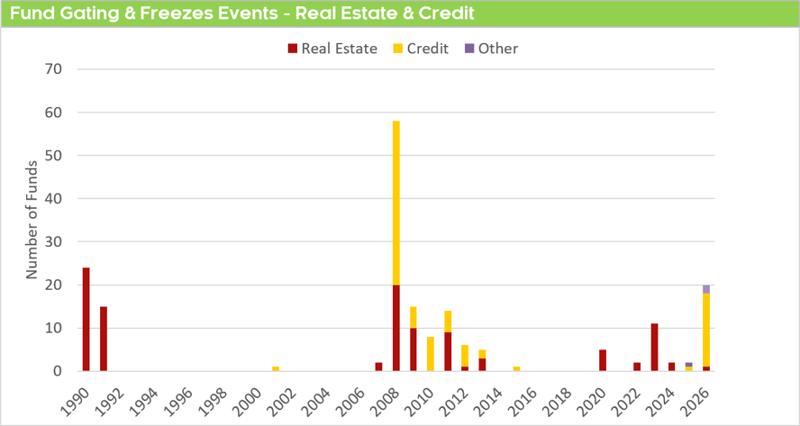
In the early 1990s, rising rates followed a commercial property boom, which drove suspensions to forestall widespread distressed asset sales to fund redemptions. During the GFC, a sudden loss of investor confidence collapsed property and credit markets, also prompting redemption runs. Between 2022 – 2026, another series of rapid rises in interest rates along with broader macro issues, again exposed liquidity mismatches.
Given the inherent mismatch between investor expectations of access to capital and the reality that assets can usually only be sold or repaid over extended periods (particularly during market stress), liquidity tightening should be an expected feature of these products, versus liquid assets where the ability to pivot is largely frictionless.
How might advisers address these issues for clients?
Decisions advisers make in the first few redemption windows can matter as much as the original allocation. The key steps should be simple.
- Talk to clients early. As with all scenarios involving disruption, keeping clients informed is key. The starting point is being clear about what a ‘gate’ is. They are generally capped to some level, often around 2.5% - 5% per window. Their purpose is to typically to stop managers selling assets at distressed prices to meet withdrawals.
- Show the client exactly what's locked. The first step arguably is education. Which holdings are liquid? Which aren't? What are the redemption limits? How do each of these fit against a client's goals and cash needs?
- Avoid oversubscribing. Investors often decide to oversubscribe for the next withdrawal when redemptions are limited ‘to get more back’. By default, the queue gets longer for everyone and redemption crowding feeds on itself. As an alternative, advisers might be better served separating clients needing cash from those who are simply uneasy. For the first group, the question is how much of that need can the liquid part of their portfolio cover.
- Rebalance around the frozen fund, not through it. In most cases, this will not be fixed overnight. Rebalance using whatever cash is available, and move gradually towards a better mix as redemption windows open.
Ultimately, when a gate closes, many clients first reaction is ‘I want out’. The reaction is not unreasonable. The client conversation is the hardest part. Most clients are used to having liquidity and being able to sell when they are nervous, so it’s understandable when investors react badly to being told they can’t get their money out.
Most advisers understand managing clients' emotional reactions to risk is an intensive exercise in either mitigation or neutralisation. Clear communication and long-term framing often work better than changing the strategy. There is no doubt that redemption risk alienates investors, but those who are best educated on the issues are better equipped to manage through it. The conversation that matters most happens before the gate, not after it.
Can the spectre of liquidity mismatching be solved?
Given that challenges around private market assets can pose a significant barrier to their positive attributes, what should the industry be doing to prepare clients?
Risk profiles might answer the wrong question
Traditionally, most portfolio construction for clients still starts with a risk profile. We believe there’s an argument for a different starting point when dealing with private markets. Why? The real constraint on private market allocations is likely not risk tolerance. It’s liquidity tolerance.
In their simplest forms, a risk profile measures how much volatility a client can stomach. But it doesn’t address whether they can live without part of their capital for two or three years. As an industry, we should attempt to separate psychological risk tolerance from risk capacity. We could argue that many investors who sell in a market crisis have not run out of money - they ran out of emotional liquidity. It’s logical that people feel the potential loss of returns more keenly when combined with being locked in place. As such, ‘Illiquidity budgeting’ should be a consideration around a client’s illiquidity tolerance across varying time horizons.
Why a liquidity budget can matter more than an asset allocation target
Unlisted valuations typically move slowly. Given that gating often reveals itself during turbulent periods, as listed markets fall the private sleeve grows as a share of the portfolio. This makes rebalancing harder because the overweight assets cannot easily be sold, so every adjustment falls on the liquid holdings at the worst time.
There is a scenario where a liquidity budget should be set first. For each client, that means estimating:
- known cash needs over the next few years
- the liquid capital needed to rebalance, particularly after a sharp fall in listed markets, and
- a buffer that assumes every private market exposure held is gated at once.
What remains is the capacity for illiquid assets. For many clients, particularly retirees drawing a pension, that may sit well below what their risk profile implies. Clients probably need to ask themselves, if a fund were gated for 12-18 months, what would we have to sell instead? If the answer is uncomfortable, the allocation is probably too large.
Are there other alternatives?
Listed vehicles such as Listed Investment Trusts (LITs) offer a different trade-off for private market liquidity. LITs can be traded on the ASX but while liquidity is present on market, you substitute liquidity for price volatility and the potential for units to trade away from Net Asset Value (NAV). This has been a long running feature of listed real estate as exhibited by Australian Real Estate Investment Trusts (AREITs), many of whom were birthed out of the frozen fund crises of the 1990s, seeing listing as a pathway to liquidity for investors.
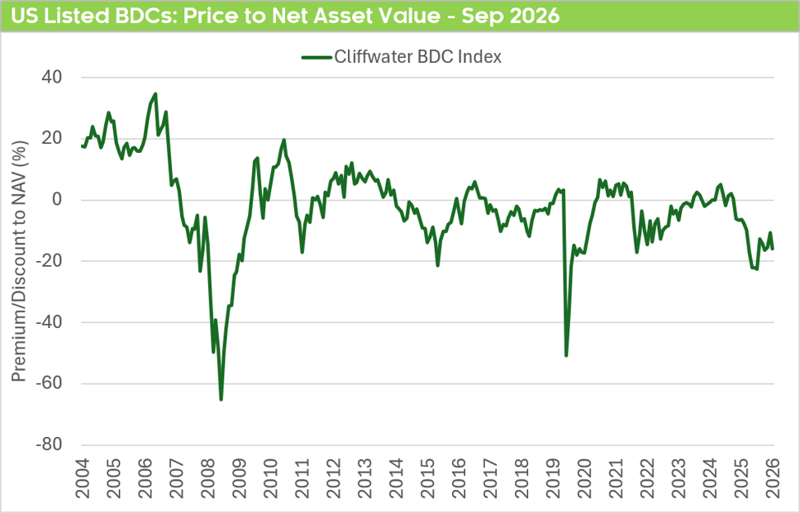
While private credit LITs do not have such an extensive record locally, US listed Business Development Companies are a close substitute, with many focussed on holding private loans frequently trading at heavy discounts (20%+). For LITs, the exit is usually open but the price may not be acceptable.
The bottom line
Liquidity crunches are not new. And while some historical cases have resulted in permanent impairment of investor capital including fund shutdowns, this is not always the case. Private markets are hardly alone in that arena. Many funds ultimately work through liquidity squeezes and continue meeting their objectives. These events are merely part of the cycle.
None of this should diminish the strategic value of private markets. They can enhance diversification and deliver compelling investment outcomes when managed well. But while giving up liquidity can be profitable, asset/liability mismatching in vehicles that offer short-term redemptions on long-dated assets will always face timing challenges. Typically, liquidity terms get tested exactly when clients most want to use them. Sizing allocations to a client's liquidity tolerance, rather than their risk profile alone, must be a durable discipline.