

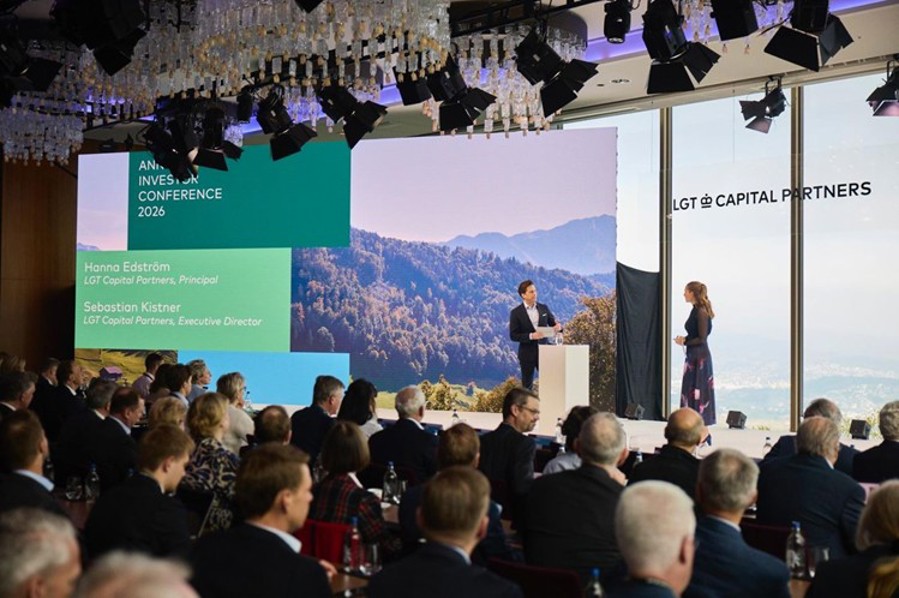
I recently spent two weeks in Switzerland attending Partners Group and LGT’s annual investor conferences. The attendee mix was varied, and spanned allocators from super funds, family offices, investment consultants, insurers, private wealth and global pension funds – of which it was estimated that more than USD10 trillion in funds under management was represented.
Importantly, LGT and Partners Group are both pioneers in managing open-ended private market strategies. And this was the marquee event in the calendar for the two groups which, importantly, coincided with the launch of Zenith’s Private Assets Portfolio (ZPAP) in partnership with Link Wealth Advice.
Overall, it was a highly valuable two weeks getting a glimpse behind the curtain to better understand how investment ideas are presented, debated and rationalised within a private market context. The topics covered the entire private market ecosystem, including private equity, private credit, infrastructure and property – with an overarching emphasis on demonstrating the rigour involved in the investment selection process.
A new golden era for infrastructure
Importantly, the content served to reinforce one of our key overweights – across both public and private markets – to infrastructure. The overwhelming consensus over both conferences was that we’re in the midst of an infrastructure super-cycle.
In large part, this is being driven by data centre growth and the electrification of the energy grid. And the AI growth underpinning these tectonic shifts is constrained by power supply, which is powering a multi-trillion-dollar investment opportunity for private capital given governments’ bloated balance sheets. This has been positioned as a once in a generation investment window given the monumental investment spend required to build out a new energy grid.
Multi-decade investment tailwinds
This is simultaneously occurring against a backdrop of increasing digitalisation, the modernisation of transport and logistics, demographic changes, and social infrastructure spending - the culmination of which provides further structural tailwinds for this investment thesis.
Critical to our favourable view on the asset class more broadly, is that these assets tend to be well insulated from macroeconomic volatility, whilst offering strong inflation hedging through long-term contracted revenues that adjust with inflation. These factors, coupled with attractive income generation, downside protection, and asymmetric upside reinforce our bullish positioning.

Secondaries surge
A growing theme across the whole gamut of private market subsectors has been the increasingly appealing opportunities presenting in ‘secondaries’ transactions. Put simply, secondaries are investments in existing private market funds or assets. Historically, these opportunities have been concentrated within private equity, with the opportunity set more recently expanding into private credit, infrastructure and property.
Underpinning this trend is the lack of exits within private markets, which has resulted in a backlog of unsold assets. Therefore, secondaries provide a liquidity solution for the ‘General Partner’ – i.e. the ‘GP’ who is the manager responsible for the private market fund who needs to satisfy redemption requests for their investors. Alternatively, secondaries also provide exit liquidity for ‘Limited Partners’ (the investors in these funds) who might have capital locked up for 10+ years yet require redemption proceeds sooner.
Privately fuming
This manufactured liquidity is often provided at a cost to the seller, with the buyer afforded a discount on the asset value. These discounts are more pronounced in ‘LP-led’ secondaries, and typically range from 5-10%, although can vary drastically depending on the asset – with extreme reports of secondaries in Chinese markets fetching more than 50%.
The benefit for the buyer is that this ‘discount’ is marked back up on day 1, resulting in an immediate capital gain. Outside of the safety buffer that buying an asset at a discount provides, there are numerous portfolio construction considerations that we believe favour secondaries.
Unreal(ised) gains
For example, investors are accessing a differentiated cashflow profile through harvesting returns earlier in the private market lifecycle. We likewise view the risk-return profile as compelling, given you’re accessing seasoned assets which reduces blind pool risk. And the countercyclical nature of secondaries means that in downturns you can negotiate wider discounts, amid stronger deal flow and faster deployment.
For all these reasons, ZPAP maintains secondaries exposure across PE, Private Credit, Infrastructure and Property. Both as a de-risked return enhancer, but also as a portfolio management tool given the higher velocity of cashflows.
The great divide
Interestingly, despite the media noise around private credit, the outlook was mostly constructive. However, the key takeaway centred on the growing divergence in returns amongst private credit managers.
The high-profile defaults have been concentrated in junior debt and/or cyclical sectors, which pleasingly, we retain minimal exposure to. Instead, we remain focussed on senior secured lending which continues to offer attractive return prospects.
However, there are signs of speculative activity emerging through a weakening of credit protections, as many mega-cap deals offer no meaningful covenants. Similarly, the increasing reliance on payment-in-kind interest (PIK) within some subsets also warrants close scrutiny (i.e. is it an established company that's deteriorating or a younger company that’s rapidly growing).
Not so fast!
Overall, the expectation is for greater dispersion, particularly where AI ‘winners and losers’ are involved. The view was that in many instances, credit spreads still aren’t adequately compensating for the coming ‘Saas-pocalypse’, reiterating the importance of manager selection.
Regarding the emerging liquidity stresses, for the most part these have been contained to overleveraged managers with a US focus, high borrower concentration, a retail investor-base, low liquidity and overexposure to software. This bears no resemblance to the investments held within our portfolio.
The AI arms race
Naturally, no investment conference would be complete without a heavy dose of AI insights, and this was no different. To broadly summarise, AI is being incorporated across the following dimensions:
- enhancing top-down macro views within scenario analysis
- creating efficiencies across processes and investment analysis, and
- utilising AI/machine learning for more esoteric hedge fund strategies.
The chips are down
This highlighted the importance of partnering with fund managers where AI integration is tightly intertwined in their processes, which requires a robust platform to capture the data points – both external and proprietary – and turn them into actionable investment decisions.
Economy wide, the view is that we’re currently in the midst of the first wave of AI adoption which is transforming business processes. This is reliant on AI systems to streamline tasks and processes, which is having a negligible impact on employment as most business models are largely unchanged.
It’s the coming reconfiguring of entire businesses models that will open up limitless opportunities (and threats) to investors with AI advancements, automation and robotics.
Performance follows process
The private markets landscape is undergoing one of its most significant transformations in decades. As the space becomes increasingly available to retail investors, this elevates the importance of due diligence, asset allocation and manager selection.
As the opportunity set expands, we’ll continue our close collaboration with our Research Team to uncover the most compelling opportunities to build diversified portfolios with uncorrelated return streams. Importantly, this environment demands clarity of thinking, disciplined positioning and a long-term orientation that lends itself to private market investing.
A different flight path
While the near-term outlook is clouded by geopolitical uncertainty and macroeconomic cross-currents, our conviction in the Zenith Private Assets Portfolio is unchanged, and we remain excited by the pipeline of investment opportunities that lay ahead.