

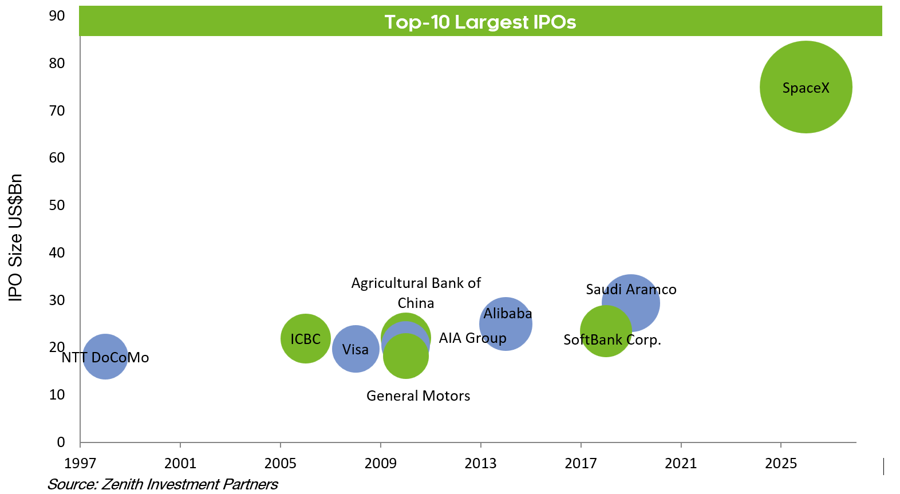
The hotly anticipated initial public offering (IPO) of SpaceX blasted off on the NASDAQ on Friday 12 June, culminating in a record-setting listing of US$75 billion. Elon Musk’s rocket and satellite company delivered the largest public listing in history, comfortably eclipsing previous record holders including Saudi Aramco, Alibaba, Visa and SoftBank.
Demand for the IPO was reportedly oversubscribed by approximately four times, underscoring the extraordinary level of investor interest in one of the world’s most closely watched private companies. For years, SpaceX occupied mythical status among investors. Unless you were a private equity or sovereign wealth fund, gaining exposure was exceptionally challenging.
To put this blockbuster raising in perspective, below are the top 10 largest IPOs on record, all of which have been dwarfed by the mammoth listing of SpaceX.
While SpaceX is often viewed through the lens of rocket launches and ambitions of colonising Mars, a growing share of the investment case rests on Starlink. The satellite internet business now provides connectivity across more than 150 countries and has become one of the fastest-growing telecommunications networks in history.
High wire act
For a growing cohort of ‘passive’ investors, there’s intense interest around when SpaceX will be incorporated into the benchmarks that underpin index tracking funds. Where Zenith utilises passive large-cap international equity strategies, these generally track the MSCI World Index.
Given its size, SpaceX has qualified for MSCI’s fast-track IPO inclusion process, which allows large new listings to enter major indices much sooner than the traditional quarterly review cycle. This will see SpaceX purchased by strategies that track the MSCI World on 29 June, triggering purchases from the vast number of passive funds and ETFs benchmarked to MSCI indices. This creates a powerful second wave of demand beyond the IPO itself.
Interestingly, the NASDAQ has introduced fast-entry rules that allow SpaceX to qualify for accelerated inclusion into the NASDAQ-100 index, where it would immediately become one of the largest constituents. While the eventual inclusion in the S&P 500 remains a possibility, admission is subject to stricter eligibility requirements, including four quarters of positive earnings, and the index committee has opted not to fast-track the process.
Don’t believe the hype
The active managers that we’ve spoken to have taken markedly varied approaches to the SpaceX IPO. Many avoided the listing altogether due to mandate constraints which prevent pre-IPO exposure, or had screened out the stock believing that the valuation had become too stretched to justify an investment.
A select few participated directly, attracted by the company’s dominant market position and long-term growth potential. A third group took a more nuanced approach and purchased shares around the IPO despite valuation concerns, recognising that a company of SpaceX’s size could quickly become a major benchmark constituent. For managers with low tracking error mandates, being significantly underweight can sometimes present as much risk as owning the stock itself.
Investing at high altitude
While SpaceX has understandably dominated headlines, recent reporting suggests that it might represent the first of a string of upcoming high-profile public listings.
Private markets remain home to a range of AI-related businesses that have yet to list publicly. Companies such as OpenAI and Anthropic have all garnered eye-watering private market valuations, with OpenAI recently filing for another blockbuster IPO, likely later this year.
As private equity-backed AI businesses mature and seek liquidity, public markets could experience the largest technology IPO cycle since the dot-com era. However, unlike many of the speculative listings of the late 1990s, today’s leading AI businesses are already generating meaningful revenues and serving customers at scale.
One small step for SpaceX…
The significance of the SpaceX IPO extends beyond its record-breaking size. For years, some of the world’s most innovative and fastest-growing companies have remained private for longer, limiting the ability of everyday investors to participate in their growth.
Pleasingly, the successful listing of SpaceX may encourage other high-profile private companies to follow suit. Importantly, this expands the investable universe of public companies and increases exposure to innovation and growth for retail investors.
Of course, even great companies don’t necessarily make great investments, and history is replete with examples of hot IPOs which ultimately fizzed. Nevertheless, if SpaceX marks the beginning of a new wave of AI and technology-oriented listings, investors may be witnessing one of the most significant shifts in public markets for more than a decade.
Although SpaceX has reached orbit, the next generation of AI-driven IPOs is still on the launch pad, preparing to reshape the investment landscape.